Divided but Together: Moving a Large Chelsea Party to the Airport in Two Cars
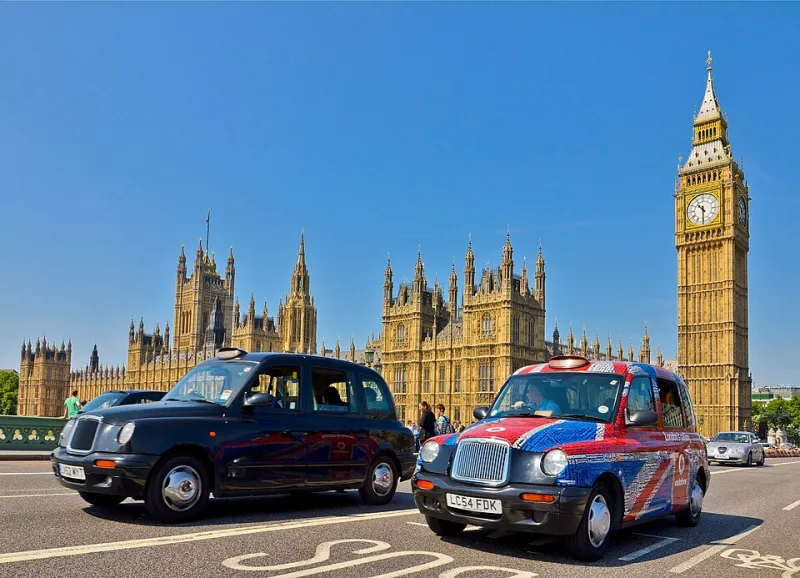
Photo: Pedro Lastra, CC0, via Wikimedia Commons
A group departure from Chelsea often begins with the same reasonable assumption: one vehicle, one journey, one arrival. For two or three travellers, that holds. For six, seven or eight people with hold luggage and cabin bags, it frequently does not. The choice is not simply between one cab and two; it is between a plan that keeps the party together in spirit and a scramble that separates people from passports, bags and patience.
When two cars genuinely earn their place
Two cars make sense when the party is large enough that a single standard vehicle would be cramped, when luggage is bulky rather than merely numerous, or when the group is gathering from more than one Chelsea address. A family party of seven leaving from near Sloane Square, with one branch staying off the Fulham Road, may find two cars simpler than one large vehicle threading through side streets to collect everyone.
Two cars also help when the group includes several tall adults and long-haul luggage. Seat count alone is a poor measure of comfort. An eight-seat vehicle full of people may have very little boot space left for suitcases, and a party that has packed for a fortnight will notice.
They are less suitable when the group includes young children requiring child seats, when one member has accessibility needs that are easier to manage in a single vehicle, or when the party is all at one address with moderate luggage and a properly sized MPV is available. In those cases, one larger vehicle usually produces the calmer morning.
The passenger-and-bag split
The first principle is simple: nobody should be separated from their own luggage. Each car should carry the passengers whose bags are in its boot. Sending bags in one car and their owners in another invites confusion at the terminal, particularly at Heathrow, where drop-off areas are busy and drivers cannot wait indefinitely.
The practical split is usually by household, by room, or by working team. A family group might put parents and younger children in one car and older children with their own cases in the second. A business delegation might divide by team, keeping presentation materials with the person responsible for them. In every case, appoint a lead passenger for each car — someone who holds the other lead's mobile number and can make a decision without consulting the whole group.
Passports, medication, keys and valuables should stay with their owners, not in a shared bag in the other boot. Labelling cases is old-fashioned advice that remains useful.
Timing two cars to one terminal
Two cars should not be booked to arrive at the same minute from different parts of Chelsea. They should be booked to reach the terminal within a few minutes of each other. Give the operator one instruction: two cars, same flight, same terminal, same desired arrival window. The drivers can then be scheduled with the rendezvous in mind rather than each working to a separate brief.
If both cars serve the same flight and terminal, agree a meeting point inside the terminal before the day. At Heathrow Terminal 5, that might be near the check-in zone for the relevant airline; at Gatwick, it might be by the departures information board. Avoid relying on finding one another at the kerbside, where vehicles must keep moving. One lead passenger should wait at the agreed point while the other brings their group through.
Where the party is flying from different terminals — which is unusual for a single booking but possible with separate airlines — two cars are not merely convenient but necessary. In that case, agree to meet after security only if the departure times allow it. Otherwise, treat the terminal arrival as the end of the shared journey and the start of two separate ones.
Briefing both drivers
Both drivers should receive the same core information: flight number, terminal, airline, desired arrival time and the name of the lead passenger in each car. Each driver also needs the passenger list for their own vehicle and an accurate count of hold and cabin bags. Child seats, accessibility requirements and any oversize items should be stated at booking, not mentioned at the kerb.
Ask the operator to note that two cars are travelling together as one party. This allows the drivers to be given each other's details or, at minimum, to be dispatched with a common arrival target. The lead passengers should text each other when their car is five minutes away, so the first to arrive can hold the meeting point.
The fair cost split
Decide the fare arrangement before booking. The simplest methods are equal division per adult, division by household, or one person paying and being reimbursed. Equal division is easiest to explain, though it can feel slightly unfair if one car has collected from farther away. Division by household tends to satisfy larger family groups; a single invoice suits a business delegation.
Avoid itemising luggage or negotiating over who had the heavier case. It lengthens the conversation and rarely produces a fairer result. If each car is tipped, tip each driver separately and keep the receipts together. Booking two cars as one job also gives the operator a clear record if a question arises later.
The larger-vehicle alternative
A large party should not assume two cars are automatically cheaper or better. One properly sized MPV or van can be the wiser choice when everyone is at one address and luggage is moderate. The test is not how many seats the vehicle has but how much boot space remains once those seats are filled. Ask the operator directly about luggage capacity in relation to your actual cases.
Two cars often beat one when the group is spread across Chelsea, when luggage is genuinely bulky, or when separate conversations and a little breathing space would improve the journey. One larger vehicle often beats two when children, accessibility or single-drop-off simplicity matter more than space.
A short checklist before booking
- Count passengers and bags, separating hold luggage from cabin bags.
- Split by household or team, and appoint a lead passenger per car.
- Confirm that both cars serve the same terminal and flight.
- Book the two cars in one instruction with a shared arrival window.
- Agree a meeting point inside the terminal.
- Settle the cost method in advance and keep receipts together.
Chelsea's residential streets reward a little courtesy. If both cars are collecting from the same road, stagger the pickups by a few minutes rather than blocking the kerb with two engines idling. The aim is one calm arrival at the airport, even if it is made in two parts.